Fund performance
Merrill Lynch Fund Track Record.
Fund track record as CEO and CIO of the Merrill Lynch joint venture: Merrill Lynch Zen Asset Finance Fund Ltd.
Merrill Lynch Zen Asset Finance Fund Ltd.
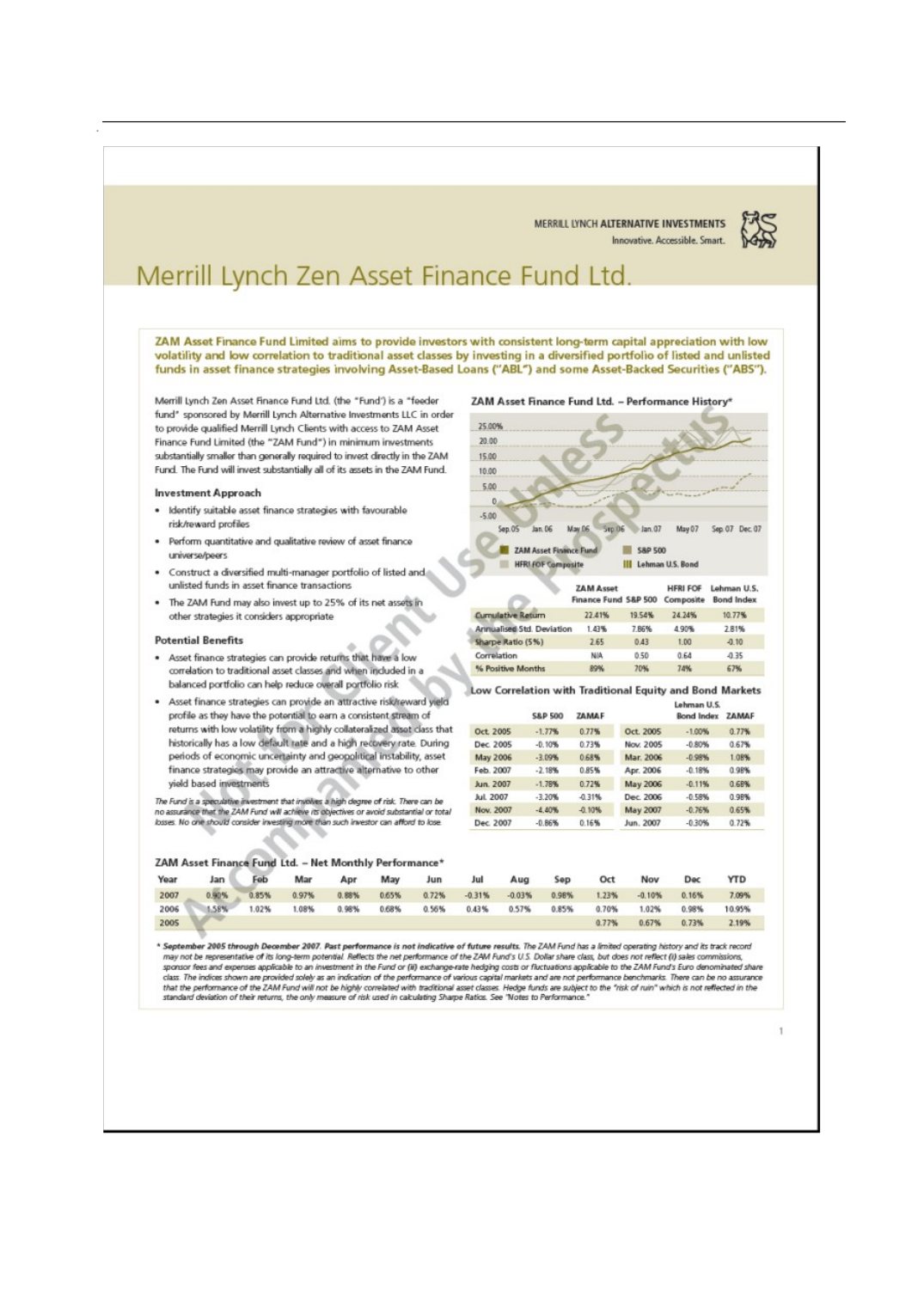
The fund aims to provide investors with consistent long-term capital appreciation with low volatility and low correlation to traditional asset classes, by investing in a diversified portfolio of listed and unlisted funds in asset finance strategies involving Asset-Based Loans (ABL) and some Asset-Backed Securities (ABS).
It is a feeder fund sponsored by Merrill Lynch Alternative Investments LLC to give qualified Merrill Lynch clients access to ZAM Asset Finance Fund Limited in minimum investments substantially smaller than those generally required to invest directly.
Investment approach
- Identify suitable asset finance strategies with favourable risk/reward profiles.
- Perform quantitative and qualitative review of the asset finance universe and peers.
- Construct a diversified multi-manager portfolio of listed and unlisted funds.
- Up to 25% of net assets may be invested in other appropriate strategies.
Reproduced from the finance biography document.
Performance summary
September 2005 – December 2007.
| ZAM Asset Finance Fund | S&P 500 | HFRI FOF Composite | Lehman U.S. Bond Index | |
|---|---|---|---|---|
| Cumulative Return | 22.41% | 19.54% | 24.24% | 10.77% |
| Annualised Std. Deviation | 1.43% | 7.86% | 4.90% | 2.81% |
| Sharpe Ratio (5%) | 2.65 | 0.43 | 1.00 | -0.10 |
| Correlation | N/A | 0.50 | 0.64 | -0.35 |
| % Positive Months | 89% | 70% | 74% | 67% |
2007
7.09%
Year to date, net
2006
10.95%
Year to date, net
2005
2.19%
Year to date, net
Past performance is not indicative of future results. The ZAM Fund has a limited operating history and its track record may not be representative of its long-term potential. Figures reflect the net performance of the fund's U.S. Dollar share class and do not reflect sales commissions, sponsor fees and expenses, or exchange-rate hedging costs. The indices shown are an indication of the performance of various capital markets and are not performance benchmarks. Hedge funds are subject to the "risk of ruin", which is not reflected in the standard deviation of their returns.